All Projects
REVIEW CARD
Asking for a rating at the right moment, and listening properly when users aren't happy.

Only 1.41% of users who opened Rooter ever rated us, and more than half of those ratings were 1 or 2 stars. The rating card showed up at random points, and unhappy users were asked the wrong question. I redesigned the flow in three ways. We now ask only after moments where users are clearly enjoying the app. Unhappy users get a quick way to tell us what's wrong. And every piece of feedback gets a clear response.
Rating rate went from 1.41% to X% in Y weeks.
01
Why this mattered
Rooter is a gaming and live streaming app. On the Play Store, our rating and review count decide how high we show up in search and whether a new user trusts us enough to install. Good reviews bring in users for free. Bad reviews push them away before they've even tried the app.
02
Why this mattered
Rooter is a gaming and live streaming app. On the Play Store, our rating and review count decide how high we show up in search and whether a new user trusts us enough to install. Good reviews bring in users for free. Bad reviews push them away before they've even tried the app.
Where we stood
We asked for ratings in two places.
1. A feedback card in the For You feed
It asked "How satisfied are you with Rooter?" with five emoji faces. If you picked 4 or 5, we redirected you to the Play Store. If you picked 1 to 3, a text box opened asking "What do you like most?"


2. A "Share your feedback" button at the bottom of the side nav.
It opened a pop-up asking "Enjoying the Rooter App?"

The numbers
-
1.41% of users who launched the app gave a rating, and that number stayed flat.
-
70% of ratings (77,595) came from the side nav button, and only.
-
30% (33,417) from the feed card. The card we'd placed in front of everyone was doing less than a button hidden in a menu.
-
Ratings were split to the extremes: 52% were 1 or 2 stars, 29% were 5 stars, and very few were in between.

What I found was wrong
Looking at the flow and the data together, I saw three problems.
The card had no sense of timing
Someone who had just watched their favourite streamer for an hour and someone whose stream kept buffering got the exact same ask.
We asked unhappy users the wrong question
A user who gave us 1 star was asked "What do you like most?" in an empty text box. That's the wrong question, and typing out a complaint is effort most people won't make. So our unhappiest users, who made up half of all ratings, gave us almost nothing we could act on.
We were working against Google's rules
Google's in-app review guidelines say the review card can't be changed or covered, and that Google controls how often it can appear. They also say apps shouldn't use a button to trigger it, because the card may not appear if the user has hit Google's limit.
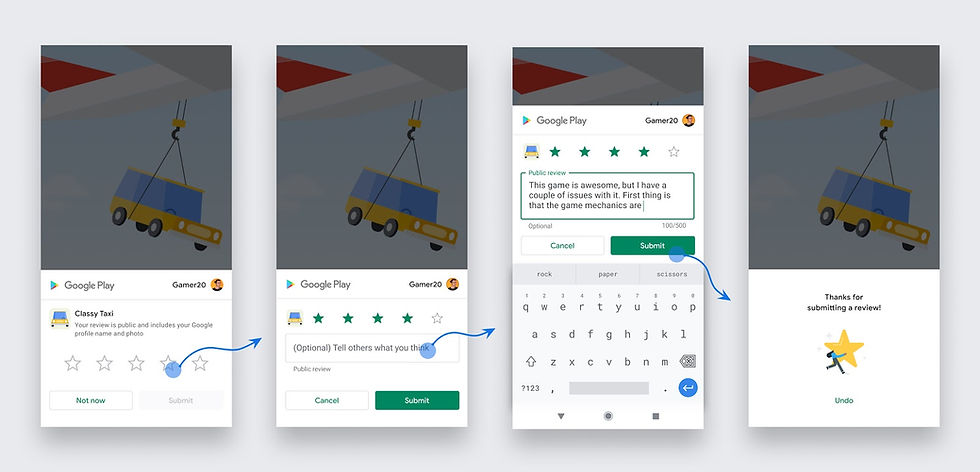
Source: Android Developers
The question I started from
Since Google locks down the review card itself, my real lever was timing. So the question became: **when is a user most likely to be happy with Rooter?**
Finding the happy moments
First, I checked who was already rating us. Users who interacted with the rating card had **68.1% D1 retention**, and still **52.2% by day 5**. People who rate are our most engaged users. That told me engagement was the right signal to look for.

Retention of users who interacted with rating card
Then I worked with [the data team / PM] to find which actions were most linked to users coming back the next day: